Play Singapore Mahjong with The Good Life Club
Welcome to The Good Life Club, our dedicated space for like-minded "gems" who share our desire to live the Good Life. At Carrie K., our mission is simple: To spark joy by uplifting and inspiring thoughtful celebrations of people’s lives and love. Creating this vibrant community is our way of doing just that, forging connections through meaningful, story-filled jewellery that sparks conversation and growing together in pursuit of a life filled with vitality, joy, and love.
Now, we’re taking those connections straight to the mahjong table for our first official Good Life Club event: a Mahjong Party. Read on for the ultimate guide to the rules of Singapore mahjong and an insider peek at Carrie K.’s mahjong-inspired fine jewellery.
Why is Carrie K. focusing on Mahjong?
If you've spent any time on social media lately, you've probably noticed it too. Mahjong isn't just making a comeback; it's becoming a cultural phenomenon. From trendy cafés hosting mahjong nights to luxury fashion brands reimagining the iconic tiles, mahjong has evolved far beyond the traditional game grandparents play.
Today, mahjong is a lifestyle; a reason to gather; a conversation starter; a way for friends, families and communities to connect in an increasingly digital world. At Carrie K., we've always believed that meaningful jewellery should celebrate life's moments. So when we saw mahjong bringing people together across generations, it felt only natural to create something that celebrates this shared joy. Because mahjong isn’t only about winning; it's about the conversations and stories that unfold around the table.
Singapore Mahjong Tiles
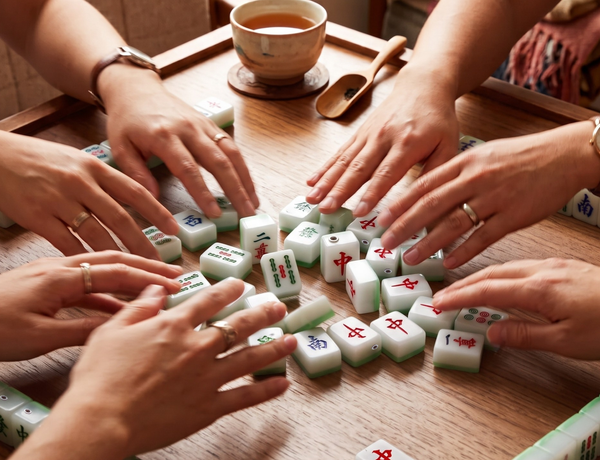
Across the globe, different cultures have their own mahjong rules and quirks. Don’t worry, this guide will only focus on the rules and playing style of Singapore mahjong. To get it out of the way: Yes, there are many tiles, 148 to be exact, with suit, wind, dragon, flower, and animal tiles.
Suit tiles

There are 3 main suits in Mahjong: Circle (Tong 筒), Bamboo (Suo 索), and Character (Wan 萬). Each suit is numbered from 1 to 9, and there are 4 of each tile. Circle and bamboo tiles are the easiest to count (count the dots and sticks), but try your best to familiarise yourself with the Chinese characters for 1 to 9.
Do note that the first tile of the bamboo suit is represented as a bird; do not confuse it with an animal tile (see the Bonus tiles section). Typically depicted as a sparrow, it might look different depending on the set that you’re playing.
Honour tiles

There are Honour tiles, including the Wind and Dragon tiles.
The wind tiles start from East (Dong 东) to South (Nan 南), West (Xi 西), and North (Bei 北), unlike our typical “North, South, East, and West”. There are 4 of each tile; familiarise yourself with the characters of the wind tiles.
There are also the dragon tiles: Hong Zhong (红中), Fa Cai (發財), and Bai Ban (白板). They’re sometimes dubbed as the red, green, and white dragons. There are only 4 of each dragon tile.
Bonus tiles
 Lastly, there are the Bonus tiles: the Flower and Animal tiles. There are two sets of flower tiles: one red and one blue, numbered from 1 to 4. Do take special note of the numbers on the tiles, as each number corresponds to each player. There is only 1 of each animal tile, including Cat, Rat, Rooster, and Centipede. The flower and animal tiles will not be part of your winning hand, but they’ll help you win extra points and money.
How many rounds are there in a game of Singapore Mahjong?
There are four rounds in Mahjong, each round corresponding to the table’s wind: East (东) to South (南), West (西), and North (北)—not to be confused with the players’ winds.
Player 1 is East and the dealer (Zhuang Jia 莊家); Player 2 is South, Player 3 is West, and Player 4 is North. If Player 1 wins the game, they will continue as the dealer (Lian Zhuang 连莊). If another player wins the round, the dealer status will move down, so Player 2 becomes the dealer.
The game proceeds to the South round only after every player has a turn as the dealer. This continues until the game ends in the North round.
Setting up a round of Singapore Mahjong
There are many ways to choose your seat. The most common way is to roll the dice, and the player with the highest number will draw a face-down wind tile, followed by the second highest, and so on. The player who picks East (东) will be Player 1; South (南) will be Player 2; West (西) will be Player 3; and North (北) will be Player 4. Player 1 will choose where they sit, and all players will be seated from Player 1 to 4 in a counterclockwise direction around the table.

All 148 tiles are flipped face down and aggressively scrambled. This iconic, beautifully loud group-shuffle is the mahjong equivalent of shuffling a deck of cards. In Chinese, this chaotic mixing is called "Dry Swimming (游乾水)". Absolutely zero skill is required. Just use both hands and make as much noise as possible.

Each player will build a wall of two rows of tiles stacked face down. Players 1 and 3 will build 19 stacks, while Players 2 and 4 will build 18 stacks in front of them.
The walls are sometimes angled to create extra space on the table, making it easier for players to reach and draw new tiles. Player 1 will then roll the dice to find out where to start drawing the tiles.

Add the numbers on the dice and start counting counterclockwise from Player 1 until you land on a player. If the sum comes to 8, the count should stop at Player 4.
Using the same sum from the dice, count the stack in front of the player from the right. The next tiles to the left will be the start of the wall. Everyone will draw 2 stacks at a time (4 tiles) clockwise, starting with Player 1.

Everyone will draw three sets of 4 tiles until all players have 12 tiles.

For the last draw, Player 1 will draw 2 tiles, while everyone else will draw 1. Follow the illustration above for the drawing sequence. Player 1 will often draw both tiles together; this is called the jump (Tiao 跳).
Stand your tiles up in a neat row facing you. If you drew any bonus tiles, lay them out face up in front of your hand—in your personal "garden". Replace the bonus tiles by drawing from the back end of the wall, starting with Player 1, and add them to your concealed hand. Once the replacements are done, Player 1 kicks off the game by discarding the first tile.
Actions during a game of Singapore Mahjong
A rule of thumb in mahjong: Always take a tile and discard one during your turn. You can take a fresh tile from the wall or snatch someone’s discard with actions such as Chi (吃), Pong (碰), or Gang (杠). These actions can only be performed on tiles that have just been discarded to the middle of the table—sometimes known as the pool or discard area. Any tiles discarded prior cannot be taken.

Chi lets you build a set of 3 tiles of the same suit in ascending order, and it can only be performed if the person sitting to your left discards it. You can only Chi suit tiles; you cannot Chi honour tiles.
Pong builds a set of 3 identical tiles from the same suit. It can be performed whenever any player discards a tile you need, and can be done to suit and honour tiles.
Gang builds a set of 4 identical tiles from the same suit. It can be performed whenever any player discards a tile you need. If you Gang, you’ll need to draw an additional tile from the end of the wall to ensure you have sufficient tiles for a winning hand. If you have a concealed Gang (An Gang 暗杠)—when you draw the fourth identical tile from the wall instead of taking a discarded tile, you’ll need to place the set face down and take a tile from the tail end of the wall.
If you form a Chi, Pong, or Gang from another player’s discarded tile, place the set in front of you. The combinations and tiles cannot be swapped with the tiles in your concealed hand. But if you drew the tiles from the wall and they’re still concealed in your hands, you don’t have to show them, plus you can still strategise the sets you want to build.
How to win a round of Singapore Mahjong?
You’ll need a winning hand of four complete sets of Chi, Pong, or Gang and a pair—called eyes (Yan Jing 眼睛). In total, you should have 14 tiles if you have 4 sets of three (no Gang sets).
If someone discards your winning tile, announce it by saying “Hu (胡)”. If someone else wants to claim the same tile, priority goes to the player who wants to Hu. The winning tile can be taken from any player. If you draw the winning tile from the wall, announce it by saying “Zi Mo (自摸)”, which means self-draw.
All the winning hands in Singapore Mahjong

Different hands award different points—better known as Tai (台). While there are many winning hands, the basic ones are Ping Hu, which has all Chi sets and no bonus tiles, and Pong Pong Hu, which has all Pong sets.
If you’re building a winning hand of Ping Hu, under Singapore rules, you cannot Kalong (靠張). This means that you’re waiting for the winning tile in the middle of a Chi. For example, you’re holding a 6-bamboo and 8-bamboo tile; you cannot wait for someone to discard a 7-bamboo tile. You’ll need to Zi Mo it.
How to get more Tai
So what happens if you draw a random mix of Chi and Pong sets? Sometimes known as Chicken Hand or Ji Hu (鸡胡), you won’t be awarded any Tai. Some houserules would require you to have at least 1 Tai, so this is where the bonus tiles come in.
You’ll gain 1 Tai if you:
-
Draw your corresponding flower tile
-
Draw an animal tile
-
Pong any dragon tile
-
Pong your corresponding wind tile
-
Pong the round’s wind tile
If you Pong your wind and it’s the same as the round’s wind, you’ll gain 2 Tai.
How to count your winnings after a round of Singapore Mahjong?
The winnings really depend on the house rule on how much 1 Tai is worth, but common stakes run 30¢/60¢ or $1/$2, though this is entirely a house-rules decision. Keep in mind that there is strictly only one winner per hand. How the table pays that single winner depends on your chosen house style.
Shooter Pays: The unlucky player who discarded the winning tile foots the entire bill alone, while the other two players get off scot-free.
Everyone Pays: The whole table chips in to pay the winner, but the shooter pays double the baseline amount as a gentle reminder to be more careful next time.
The exception to the rule is Zi Mo: if the winner draws the winning tile themselves, every single player must pay them double.
How to win more money during a round of Singapore Mahjong
There can only be one winner per round, but that doesn't mean that you’ll leave with nothing. Here’s how the bonus tiles can still help you win money, even if you don’t win the round:
-
Gang: If you Gang, everyone will pay you according to house rules. If you An Gang, the payout is double.
-
The Matching Flower: If you draw the 2 flower tiles of another player, that player will pay you; if you draw the 2 flower tiles that match your own seat wind, everyone will pay you.
-
The Flower Flush: Collect all four flower tiles of the same colour (all red or all blue).
-
The Bite (Yao 咬): When you draw a pair of the Cat and Rat tiles or Rooster and Centipede tiles, everyone will pay you.
-
Animal Kingdom: Collect all four animal tiles and you’ll gain 5 Tai and a massive instant payout.
-
Double Down: If your very opening hand (initial draw) already contains your matching seat flower or a completed animal pair, the instant cash reward doubles.
Continuing the game of Mahjong
After the first round of mahjong, the wind will shift, and Player 2 will become Player 1, and so on, while the round stays in the same wind. The round’s wind will only shift after all players have become Player 1.
And a reminder: if Player 1 wins the round, they will hold their title for the next round until someone else wins the game—this is why some games of mahjong can take up a couple of hours.
FAQ
What happens if two players claim the same discarded tile?
-
Priority goes to the player who wants to perform Hu, then Pong or Gang, and lastly Chi.
What do you do when you draw a bonus tile during your turn?
-
Place it in your “garden”, take a new tile from the tail of the wall, and continue your turn.
What happens if you draw a bonus tile from the end of the wall?
-
Add the tile to your “garden”, and draw another tile from the end of the wall.
Can you Gang after you have Pong?
-
Yes, but only if you draw the tile from the wall. It cannot be taken if someone discarded it.
What happens if nobody has any winning hands?
-
The game ends in a draw with 15 tiles left in the wall—known as the dead wall.
When Mahjong meets Jewellery
 Photo: Zhong Jade Duo (left) and Huat Jade Duo (right)
Inspired by these timeless symbols, Carrie K. reimagined two of Mahjong's most iconic tiles as wearable charms as part of its Wish Bar.
Huat (發): Success
 Photo: Huat Jade Duo
A word every Singaporean knows. "Huat" represents prosperity, growth, and abundance; not only financially, but in life's many milestones, from careers and businesses to personal achievements.
Zhong (中): Prosperity & Bullseye
 Photo: Zhong Jade Duo
"Zhong" literally means "centre" or "to hit the mark." In mahjong, drawing the Zhong tile can feel like the perfect moment. In life, it represents finding your direction, staying true to yourself, and hitting the milestones that matter most.
 Photo: Huat Jade Duo
The mahjong tile duos are custom-cut from jade, a gemstone long associated with harmony, protection, and good fortune, and these charms transform into meaningful reminders you can carry with you every day.
Just as no two mahjong games unfold the same way, no two days look alike.
Designed to transform with you, each mahjong charm features Carrie K.'s signature duō Push & Twist mechanism, allowing you to swap charms in seconds to suit your mood, outfit, or occasion. Wear Huat before an important presentation, or choose Zhong as you celebrate a milestone. Whatever the day brings, your jewellery evolves with you.
You can also mix them with other Wearable Wishes inspired by Fortune, Harmony, The Good Life, Direction, Strength, Love and Protection, then pair them with pearl strands or chains to create a look that feels right for the moment.